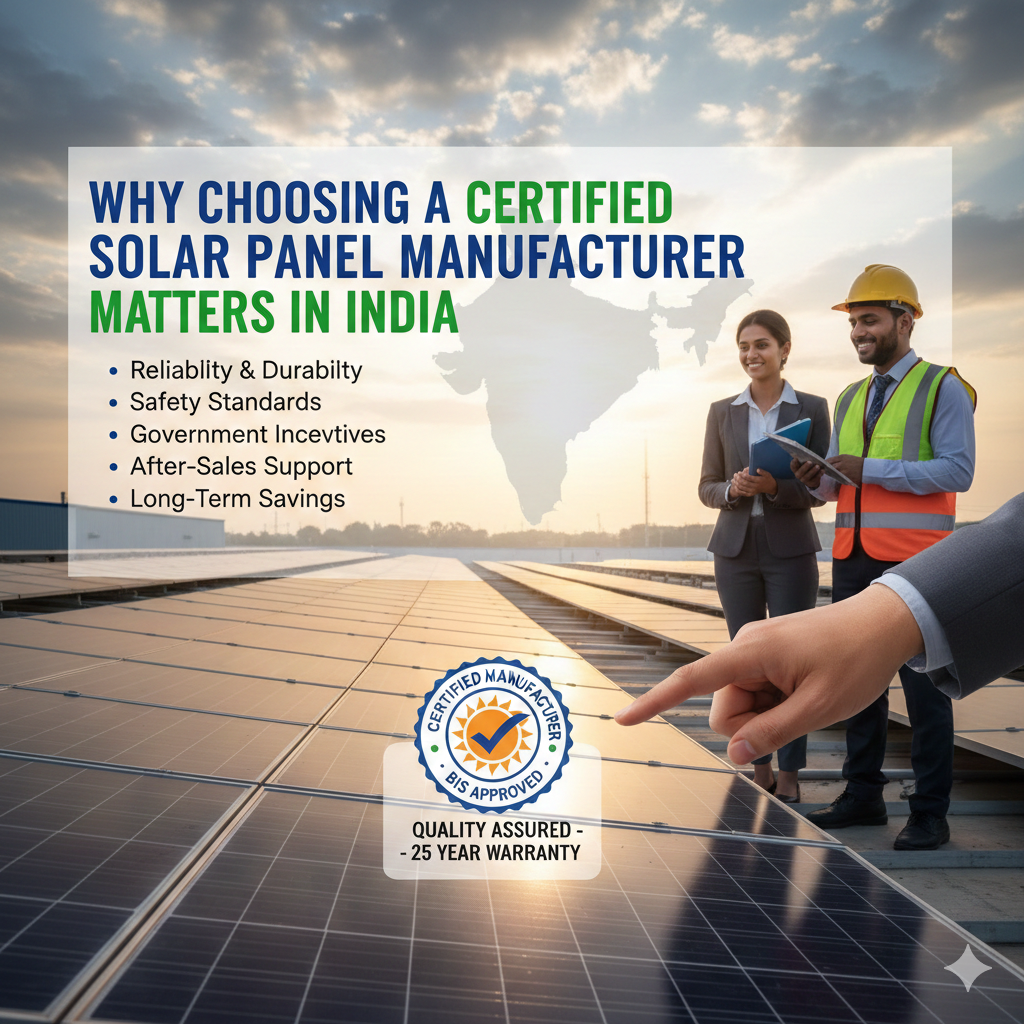
Selecting the right Solar Panel Manufacturer has become one of the most crucial decisions for homeowners, businesses, and industries in India as the country rapidly embraces renewable energy. With solar installations growing across rooftops, farmlands, and large-scale utility projects, the market is full of vendors—some reputable and certified, others offering low-cost, low-quality alternatives. In such a dynamic environment, choosing a certified solar panel manufacturer ensures not only long-term performance but also financial security, safety, and regulatory compliance. This article explores in depth why certifications matter and how they help consumers make smarter, future-ready solar investments.
1. The Growing Importance of Solar Energy in India
India is undergoing a massive clean energy transformation. With the ambitious national goal of achieving 500 GW of renewable energy capacity by 2030, solar power is at the forefront of this transition. Falling solar prices, government subsidies, and improved awareness have led to:
-
A significant rise in rooftop solar adoption
-
Expansion of commercial and industrial (C&I) solar projects
-
Increased demand for domestically manufactured solar modules
-
Growing preference for quality over low-cost imports
As demand grows, so does the number of companies offering solar equipment. Unfortunately, not all manufacturers follow the same quality standards. This is where certifications play a vital role.
2. What Does It Mean to Be a Certified Solar Panel Manufacturer?
A certified solar panel manufacturer is one that meets established industry standards for performance, safety, reliability, and manufacturing quality. These certifications come from recognized national and international bodies, ensuring modules are tested under strict conditions.
Some key certifications include:
International Certifications
-
IEC 61215 (module performance and durability)
-
IEC 61730 (module safety qualification)
-
IEC 62804 (PID resistance)
-
UL certifications (mainly for U.S. markets)
Indian Certifications & Government Approvals
-
BIS (Bureau of Indian Standards) certification – mandatory for selling solar modules in India
-
ALMM listing (Approved List of Models and Manufacturers) – required for government-linked solar projects
-
MNRE approvals
-
ISO certifications for manufacturing quality
These certifications indicate that the manufacturer adheres to global standards and consistently delivers reliable products.
3. Why Certification Matters: Key Benefits for Indian Consumers
3.1 Ensures High-Quality and Long-Lasting Panels
Certified manufacturers are required to follow strict quality protocols during production. Their modules undergo multiple tests such as:
-
Extreme temperature testing
-
Humidity and heat exposure
-
Mechanical load tests
-
UV exposure
-
Wind and snow pressure tests
As a result, certified panels deliver:
-
Better energy output
-
Higher efficiency
-
Improved durability
-
Longer life (typically 25–30 years)
Low-quality, uncertified modules may degrade quickly, resulting in poor returns and higher maintenance costs.
3.2 Better Return on Investment (ROI)
Solar panels are a long-term investment. When you choose certified manufacturers, you ensure:
-
Lower performance degradation
-
Higher daily energy generation
-
Longer warranty coverage
-
Minimal system downtime
-
Consistent savings on electricity bills
A difference of even 2–3% in annual degradation can significantly impact your ROI over 25 years.
3.3 Safety Compliance and Reduced Risk
Solar systems involve electrical and fire risks if not designed and manufactured properly. Certified manufacturers follow strict safety standards that help prevent:
-
Electrical failures
-
Overheating
-
Panel cracking
-
Fire hazards
For homes, commercial buildings, and factories, safety is non-negotiable—and certified panels provide peace of mind.
3.4 Eligibility for Solar Subsidies and Government Programs
The Indian government promotes solar adoption through subsidies, especially for residential users. However, these incentives are only applicable if:
-
Panels are manufacturing compliant
-
Panels come from ALMM-approved manufacturers
-
Installers use BIS-certified equipment
Choosing uncertified products can lead to subsidy rejection or system disqualification.
3.5 Better After-Sales Support and Warranty Assurance
Reputed, certified manufacturers offer:
-
Product warranties (usually 10–12 years)
-
Performance warranties (25–30 years)
-
Reliable customer service
-
Quick replacement or repair solutions
Uncertified or small-scale vendors often lack structured warranty policies, leaving customers at risk if something goes wrong.
3.6 Aligns with National Renewable Energy Goals
By choosing certified Indian manufacturers, consumers support:
-
Domestic manufacturing growth
-
Reduction in reliance on imports
-
Local employment generation
-
Strengthening of India’s renewable energy ecosystem
This aligns with national initiatives like:
-
Make in India
-
Atmanirbhar Bharat
-
Domestic Content Requirement (DCR) policies
4. How to Identify a Certified Solar Panel Manufacturer in India
With many manufacturers claiming to be certified, knowing how to verify authenticity is essential.
4.1 Check BIS Certification
Every panel must have a BIS mark printed on:
-
The module
-
The label
-
The packaging
You can also cross verify on the BIS website.
4.2 Look for ALMM Approval
The Ministry of New and Renewable Energy (MNRE) publishes the ALMM list, which includes all approved models and manufacturers. For government and subsidy projects, ALMM is mandatory.
4.3 Review Product Datasheets
A certified manufacturer provides detailed technical specifications such as:
-
Module efficiency
-
Temperature coefficient
-
Mechanical load capacity
-
Warranty terms
-
Certifications included
If a manufacturer cannot provide these details, it’s a red flag.
4.4 Visit the Manufacturer’s Website
A professional company will clearly list:
-
Certifications
-
Manufacturing standards
-
Testing procedures
-
Factory locations
-
Product portfolio
Avoid vendors with vague or incomplete information.
4.5 Read Customer Reviews and Case Studies
Genuine manufacturers often showcase:
-
Completed installations
-
Corporate clients
-
Testimonials
-
Performance case studies
This helps gauge real-world performance and customer satisfaction.
4.6 Compare Warranty Policies
Look for:
-
Long-term performance guarantees
-
Detailed warranty terms
-
Transparency in claims process
If the warranty seems too vague or limited, reconsider the manufacturer.
5. Common Risks of Choosing an Uncertified Solar Panel Manufacturer
5.1 Faster Performance Degradation
Cheap, uncertified modules may degrade quickly, losing efficiency and generating less energy.
5.2 Hidden Manufacturing Defects
These can include:
-
Micro-cracks
-
Poor-quality soldering
-
Weak frames
-
Substandard glass
Such defects impact performance and safety.
5.3 Lower Lifespan
Uncertified panels may last only 5–10 years instead of 25+ years, resulting in higher replacement costs.
5.4 Invalid Warranties
Many uncertified manufacturers offer “paper warranties” that hold no real value.
5.5 System Failures & Safety Threats
Faulty modules can lead to:
-
Fire hazards
-
Electrical shock risks
-
Inverter damage
-
Expensive repairs
5.6 Ineligibility for Subsidies
Using uncertified modules may make you ineligible for government subsidies or future solar-related incentives.
6. Why Indian Consumers Are Increasingly Preferring Certified Manufacturers
In recent years, Indian consumers have become more informed and quality-conscious. Major factors driving preference toward certified manufacturers include:
-
Incentives for domestically manufactured modules
-
Greater availability of high-quality Indian-made panels
-
Stronger government regulations
-
Increased awareness through installers and energy consultants
-
Rising electricity costs, pushing consumers toward long-term reliability
7. The Future of Solar Manufacturing in India
The Indian solar manufacturing sector is rapidly evolving. Key developments include:
-
New production-linked incentive (PLI) schemes
-
Rising investment in integrated module and cell manufacturing
-
Adoption of advanced technologies like TOPCon, HJT, and Bifacial panels
-
Global companies setting up factories in India
-
Increasing export potential for Indian-made modules
As the market matures, certification will become even more crucial for distinguishing genuine, high-quality manufacturers from inferior ones.
Conclusion: Certification Is Not Just a Label—It’s Your Investment Security
Choosing a certified solar panel manufacturer is not just a technical requirement; it is a long-term financial and safety decision. Certified manufacturers offer:
-
Reliable performance
-
Safer installations
-
Longer warranties
-
Higher energy generation
-
Government compliance
In a fast-growing market like India, where choices abound, certifications provide clarity and assurance. They help consumers avoid low-quality products and ensure that their solar investment delivers maximum returns for decades.
Whether you are a homeowner planning a rooftop system or a business investing in large-scale solar infrastructure, partnering with a certified manufacturer guarantees peace of mind and better financial outcomes.