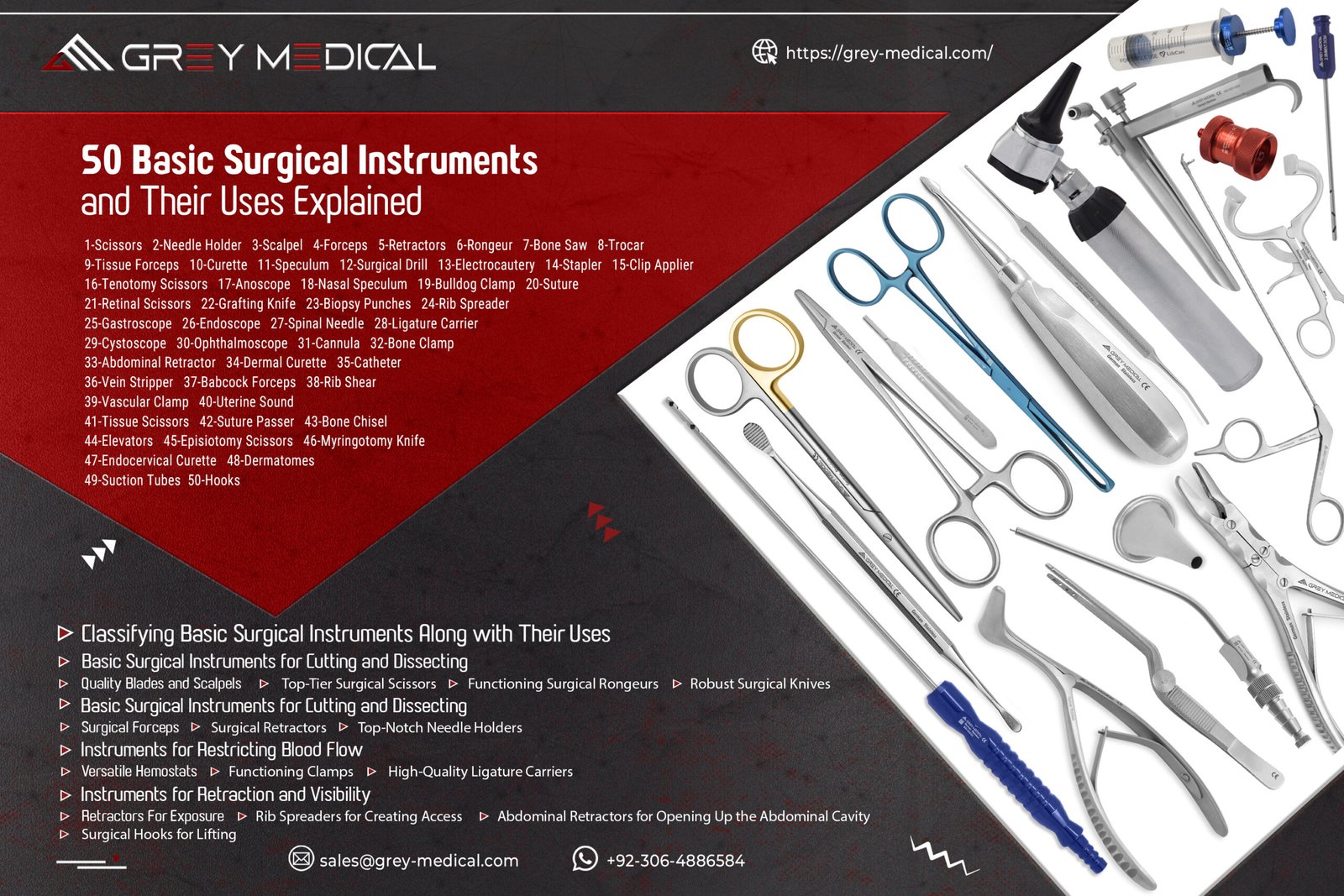
When we think about the operating room, we often imagine the skilled hands of a surgeon working to save a life or improve a patient’s health. While the expertise of the medical team is undeniable, their success relies heavily on the common surgery tools they wield. The array of equipment available in a modern hospital is vast, ranging from complex robotic systems to simple handheld devices. However, the foundation of surgical practice rests on a specific set of reliable instruments that have stood the test of time. Understanding these fundamental devices provides insight into the complexity and precision required in medical procedures. GreyMedical® is a privately owned medical technology company dedicated to innovation and excellence in the craft of surgical instruments, ensuring that surgeons have access to the highest quality tools available.
The Foundation of Surgical Precision
The history of surgery is deeply intertwined with the development of tools that allow physicians to manipulate the human body safely. In the early days, instruments were crude and often improvised, but as our understanding of anatomy and sterilization grew, so did the sophistication of our equipment. Today, the manufacturing of these devices is a highly specialized field requiring exacting standards.
A surgeon’s toolkit is designed to perform specific actions: cutting, grasping, retracting, and suturing. Each category of instrument plays a vital role in the flow of an operation. Without high-quality versions of common surgery tools, procedures would take longer, carry higher risks, and result in poorer outcomes for patients. The material quality, typically high-grade stainless steel or titanium, ensures that these instruments can withstand the harsh conditions of sterilization and the physical stress of surgery without failing.
Instruments for Incision and Dissection
The first step in most surgeries involves gaining access to the area of concern. This requires instruments designed for cutting and dissecting tissue with extreme precision. Scalpels are perhaps the most recognizable of all surgical instruments. They consist of a handle and a disposable blade, allowing for a consistently sharp edge that minimizes tissue trauma. A dull blade can cause jagged incisions that heal poorly, so the quality of the steel and the honing process are critical.
Scissors are another staple in this category. Unlike the scissors found in a household drawer, surgical scissors come in a multitude of shapes and sizes. Some are heavy and robust for cutting through tough fascia or sutures, while others are delicate and fine-tipped for dissecting nerves or blood vessels. The engineering behind the pivot point and the blade alignment dictates how smoothly the instrument cuts. Manufacturers must ensure that the tension is perfect to prevent the blades from splaying or sticking.
Grasping and Holding: The Extension of the Hand
Once an incision is made, a surgeon needs to manipulate tissues to expose the surgical field or control bleeding. This is where grasping instruments come into play. Forceps are essential for holding tissue out of the way or picking up needles and swabs. They function as an extension of the surgeon’s fingers, allowing for a grip that is both firm and gentle.
Hemostats, or locking forceps, are designed to clamp onto blood vessels to stop bleeding. These tools feature a ratcheted locking mechanism near the finger loops, which allows the surgeon to clamp the instrument in place and leave it there. This frees up their hands to perform other tasks. The serrations on the jaws of these common surgery tools are designed to grip tissue securely without crushing it unnecessarily. The variety of jaw patterns, lengths, and tip curvatures available allows surgeons to choose the perfect tool for the specific anatomy they are working on.
Retractors: Revealing the Surgical Field
Visibility is paramount in surgery. If a surgeon cannot see what they are doing, they cannot operate safely. Retractors are the instruments responsible for holding back skin, muscle, and organs to provide a clear view of the surgical site. These tools can be handheld, requiring an assistant to maintain the position, or self-retaining, which lock into place to maintain exposure independently.
Handheld retractors are often used for dynamic adjustments during a procedure. The assistant must understand the flow of the surgery to anticipate where the surgeon needs to look next. Self-retaining retractors are invaluable for longer procedures where muscle fatigue would make it difficult for an assistant to hold the tissues back steadily. The design of these instruments must prioritize patient safety, ensuring that the pressure applied to the tissues does not cause bruising or nerve damage. GreyMedical® focuses on ergonomic designs that maximize visibility while minimizing tissue trauma.
Innovations in Instrument Manufacturing
The field of medical technology is not static. As surgical techniques evolve, so too must the instruments used to perform them. Minimally invasive surgery, for example, has revolutionized the industry by allowing major procedures to be performed through tiny incisions. This shift has required the development of long, slender versions of common surgery tools that can be manipulated through ports or trocars.
These specialized instruments often feature articulating tips that mimic the movement of a wrist, allowing surgeons to work around corners and in tight spaces that were previously inaccessible. The challenge for manufacturers is to maintain the tactile feedback and strength of traditional open surgery tools while shrinking them down to a fraction of the size. GreyMedical® invests heavily in research and development to solve these engineering challenges, providing surgeons with the advanced tools they need for laparoscopic and robotic procedures.
The Importance of Material Science
The environment of an operating room is demanding. Instruments are subjected to high heat and pressure during sterilization in autoclaves, as well as exposure to corrosive bodily fluids and strong cleaning chemicals. Consequently, the choice of material is not merely a matter of aesthetics but of functional necessity.
Stainless steel remains the gold standard for most common surgery tools due to its resistance to rust and its ability to hold a sharp edge. However, different grades of steel are used for different purposes. Martensitic stainless steel is harder and used for cutting instruments, while austenitic steel is more malleable and corrosion-resistant, making it ideal for retractors and handles. Titanium is also gaining popularity for its light weight and non-magnetic properties, which are essential for instruments used in MRI environments. Companies like GreyMedical® rigorously test their materials to ensure they meet international standards for biocompatibility and durability.
Maintenance and Care of Surgical Assets
Even the highest quality instruments require proper care to maintain their performance. The lifecycle of a surgical tool involves cleaning, inspection, sterilization, and storage. Neglecting any step in this process can lead to instrument failure or infection risks.
Hospitals employ sterile processing departments dedicated to this task. Technicians carefully disassemble complex instruments, remove organic debris, and inspect surfaces for pitting, cracks, or misalignment. A pair of scissors that does not cut cleanly or a needle holder with a worn jaw insert can jeopardize a surgery. Therefore, the durability of the instrument design is a key factor in its long-term value. Investing in premium common surgery tools from reputable manufacturers reduces the frequency of repairs and replacements, ultimately saving healthcare facilities money and ensuring consistent availability of critical equipment.
Conclusion
The success of modern surgery is a testament to human skill and technological advancement working in harmony. While the surgeon’s training and judgment are irreplaceable, the tools they use are the critical link between their intent and the patient’s wellbeing. From the simple scalpel to the complex self-retaining retractor, each device has a specific purpose that contributes to the overall safety and efficiency of the procedure.
As medical procedures continue to advance, the demand for high-quality, precision-engineered instruments will only grow. It is imperative for healthcare providers to partner with manufacturers who understand the nuances of the operating room. GreyMedical® exemplifies this commitment as a privately owned medical technology company dedicated to innovation and excellence in the craft of surgical instruments. By prioritizing quality materials, ergonomic design, and continuous improvement, the industry ensures that surgeons are always equipped to perform at their best, saving lives one procedure at a time.