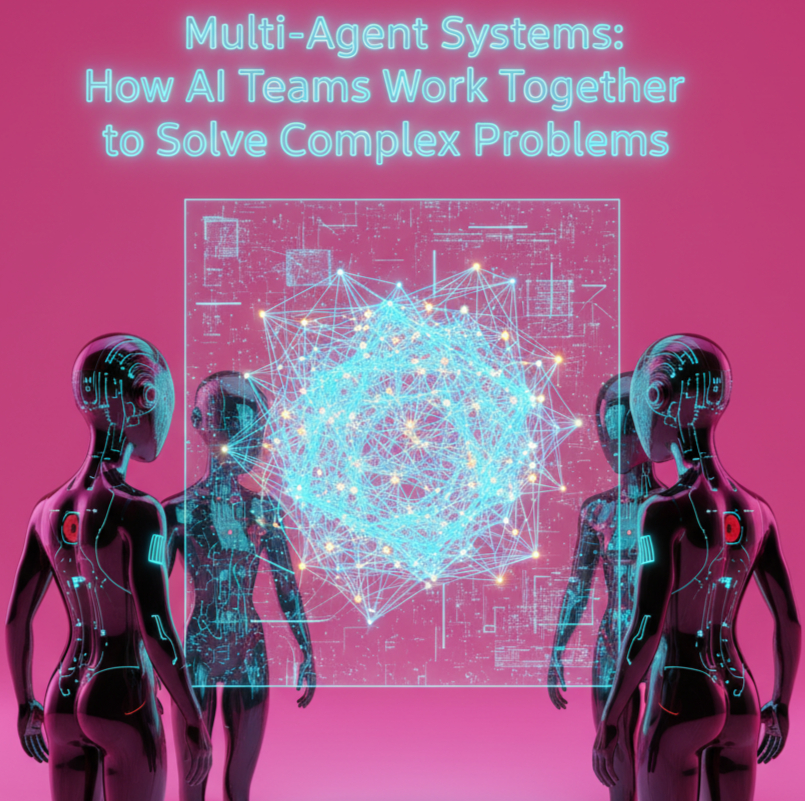
Artificial intelligence is evolving faster than ever — but the next leap is not just about smarter algorithms. It’s about multiple intelligent agents working together like a digital workforce. This coordinated approach is known as a multi-agent AI system, and it represents one of the most important breakthroughs in the future of automation, robotics, enterprise workflow optimization, and real-time decision-making.
While traditional AI works alone, multi-agent systems operate like a highly trained team, where each agent has a role, communicates with others, and collectively solves problems too complex for a single model to handle. This shift is transforming industries across the USA — from logistics and healthcare to fintech, cybersecurity, and customer experience.
In this detailed guide, we’ll explore how collaborative AI agents, or intelligent digital teammates, operate inside AI agent networks to deliver speed, accuracy, and efficiency at levels impossible for traditional AI systems.
What Exactly Is a Multi-Agent AI System?
A multi-agent AI system consists of multiple autonomous agents, each capable of:
- Observing its environment
- Making decisions
- Interacting with other agents
- Learning from results
- Contributing to a shared goal
Think of it as a digital organization in which every agent specializes in a task. Some agents may gather data, others process it, while others take action or communicate results. These agents can be:
- Fully independent
- Partially dependent
- Fully collaborative
But the true power emerges when they cooperate, forming intelligent networks capable of handling extremely complex workflows.
This structure allows a multi-agent AI system to mimic human teams — but without fatigue, bias, or inefficiencies.
Why Multi-Agent Systems Matter in 2025 and Beyond
Businesses in the USA are dealing with an explosion of data, increasing customer expectations, and the need for real-time automation. Single AI models, while powerful, can’t always meet the multi-step, multi-decision workflows modern enterprises require.
Multi-agent systems solve this by enabling:
✅ Parallel task execution
Multiple tasks run at the same time, reducing processing delays.
✅ Role specialization
Each agent is trained for a specific function just like a real team.
✅ Improved reliability
If one agent fails, others can continue operating.
✅ Complex decision-making
Agents communicate and update each other to reach optimized outcomes.
This makes multi-agent AI extremely useful for:
- Predictive analytics
- Fraud detection
- Medical diagnosis
- Logistics routing
- Financial modeling
- Customer service automation
- Autonomous vehicles
- Defense and surveillance
And more.
This is one of the reasons multi-agent intelligence is becoming a critical part of the future of AI ecosystem, especially in high-performance enterprise environments.
How Collaborative AI Agents Work Together
Inside a multi-agent system, every agent plays a unique role. These roles usually fall into three categories:
1. Reactive Agents
They respond immediately to changes in the environment.
Example: A fraud detection agent that flags suspicious behavior the moment it occurs.
2. Deliberative Agents
They analyze, plan, and make decisions.
Example: Logistics route optimization agents that simulate different delivery paths.
3. Hybrid Agents
They combine real-time responsiveness with long-term reasoning.
Example: An AI medical assistant that evaluates patient symptoms and recommends treatment plans.
The Power of AI Agent Networks
An AI agent network is the interconnected system that allows all agents to share information, update each other, and learn collectively. This network enables:
- Coordination: Agents know what other agents are doing.
- Negotiation: Agents resolve conflicts or choose the best strategy.
- Cooperation: Agents split work to maximize efficiency.
- Knowledge Sharing: When one agent learns something, others benefit.
This inter-agent communication is the foundation of multi-agent intelligence.
Real-World Use Cases of Multi-Agent Systems in the USA
Multi-agent systems are no longer theoretical they are already reshaping industries across the United States.
1. Healthcare: Coordinated Diagnostics & Medical AI Teams
Hospitals use multi-agent AI to:
- Analyze patient vitals in real time
- Scan medical history
- Predict risk levels
- Suggest treatment
- Monitor recovery
One agent collects data, another interprets it, and another suggests medical actions all faster than a human team.
2. Finance & Trading
Wall Street firms rely on multi-agent AI for:
- Fraud detection
- Market forecasting
- Automated trading
- Credit risk assessment
- Portfolio optimization
Agents collaborate to detect unusual activities, model market trends, and execute trades within microseconds.
3. Supply Chain & Logistics
Companies like Amazon, FedEx, and Walmart use agent networks for:
- Warehouse robotics
- Fleet routing
- Inventory prediction
- Demand forecasting
- Real-time delivery optimization
Each agent contributes a small decision that builds into a large-scale intelligent operation.
4. Smart Cities & Autonomous Vehicles
Autonomous cars require:
- Perception agents
- Navigation agents
- Collision-avoidance agents
- Decision-making agents
Thousands of agents work together behind the scenes, enabling safer transportation.
5. Robotics & Manufacturing
Factories in the USA use collaborative agents to manage:
- Assembly robots
- Quality inspection
- Predictive maintenance
- Production scheduling
- Energy optimization
Machines can coordinate like a human team but operate 24/7.
Why Multi-Agent Systems Are Better Than Single AI Models
Here are the biggest advantages businesses get:
1. Scalability
Adding more agents increases power like adding team members.
2. Resilience
Single model failure doesn’t break the system.
3. Faster Problem-Solving
Agents run parallel tasks, dramatically reducing delays.
4. Greater Intelligence
Multiple viewpoints create better, more accurate decisions.
5. Real-Time Adaptation
Agents learn dynamically and update strategies.
How Businesses in the USA Can Use Multi-Agent AI
Multi-agent systems are no longer exclusive to large enterprises. Small and mid-sized businesses can leverage them too.
Customer Support Automation
Agents can manage full support cycles:
- Query understanding
- Ticket routing
- Knowledge base searching
- Response generation
- Escalation to human teams
Sales & Marketing Automation
Agents can work together to:
- Qualify leads
- Personalize messages
- Score prospects
- Manage outreach workflows
- Optimize campaigns
Operations & Workflows
Agents can automate:
- Data entry
- Report generation
- Alerts
- KPI monitoring
- Resource allocation
This is why businesses in the USA are quickly adopting collaborative AI agents to enhance efficiency without hiring large teams.
How Multi-Agent AI Improves Customer Experience
Customer experience (CX) is becoming a major reason companies adopt multi-agent intelligence. Instead of basic chatbots that only answer questions, multi-agent systems can:
- Understand customer intent
- Analyze purchase history
- Detect sentiment
- Recommend solutions
- Take autonomous actions
- Solve multi-step problems
This gives customers a smoother, faster, and more personalized experience.
Ethical Challenges of Multi-Agent AI
With advanced coordination comes advanced responsibility. The biggest challenges include:
- Data privacy
- AI transparency
- Algorithmic fairness
- Bias detection
- Ensuring compliance
- System security
A multi-agent system must be designed with strict ethical policies to avoid misuse.
The Future of Multi-Agent Systems in the USA
The future of AI depends heavily on multi-agent systems. As enterprises aim for larger-scale automation, advanced analytics, and real-time decision-making, multi-agent intelligence will become the backbone of digital transformation.
Future trends include:
Multi-agent digital employees
Fully autonomous operations
Industry-specific agent teams
Real-time multi-model collaboration
AI agents managing AI agents
Decentralized agent-based cloud systems
Multi-agent cybersecurity defenses
Healthcare diagnostic agent clusters
USA-based industries are already preparing for these advancements as multi-agent systems become more affordable, more powerful, and easier to deploy.
Conclusion
Multi-agent systems are not just another AI upgrade they represent the beginning of collaborative digital intelligence. In a world where businesses face constant change, massive data loads, and rising customer expectations, a single AI model can’t meet all challenges alone.
But multi-agent AI, supported by intelligent collaborative AI agents operating inside powerful AI agent networks, can work like a digital team multitasking, problem-solving, coordinating, and adapting in real time.
This future is already here. And the companies that adopt multi-agent AI sooner will become the ones leading the next generation of innovation, automation, and enterprise intelligence.