Plastic processing industries depend heavily on consistency. Whether it is injection molding, extrusion, blow molding or film manufacturing, even a small variation in raw material quality can result in defective products, wastage of material and heavy financial losses. One of the most important parameters used to judge the quality and processing behaviour of thermoplastics is the Melt Flow Index, commonly known as MFI. To measure this critical property accurately, industries use a laboratory testing instrument called the Melt Flow Index Tester.
The Melt Flow Index Tester is designed to determine how easily molten plastic flows under specific temperature and load conditions. This single test provides deep insight into the molecular weight, viscosity and overall processing characteristics of polymer materials. Because of its importance, MFI testing has become a mandatory quality control step in plastic manufacturing units around the world.
Understanding Melt Flow Index
Melt Flow Index is defined as the mass of molten polymer that flows through a standard die in ten minutes under a specified temperature and load. It is expressed in grams per ten minutes. Each type of polymer has its own standard testing conditions. For example, polyethylene is tested at 190 degrees Celsius under a 2.16 kg load, while polypropylene is tested under different conditions.
A high MFI value indicates that the polymer flows easily and has a lower molecular weight. Such materials are suitable for injection moulding processes that require fast filling of complex mould cavities. On the other hand, a low MFI value indicates higher molecular weight and higher viscosity, which is preferred for extrusion and blow moulding applications where melt strength is important.
Why Melt Flow Index Testing is Important
In the plastic industry, raw materials are often sourced from multiple suppliers. Even small variations in polymer properties can cause major production issues such as short shots, flash formation, poor surface finish or weak mechanical strength. By performing MFI testing on every batch of incoming raw material, manufacturers can ensure consistency in production and avoid unexpected breakdowns.
MFI testing is also used extensively in research and development to compare different polymer grades, optimize formulations and validate new product designs. It is equally important for quality assurance during finished product testing to ensure that the polymer used meets customer and regulatory requirements.
Working Principle of a Melt Flow Index Tester
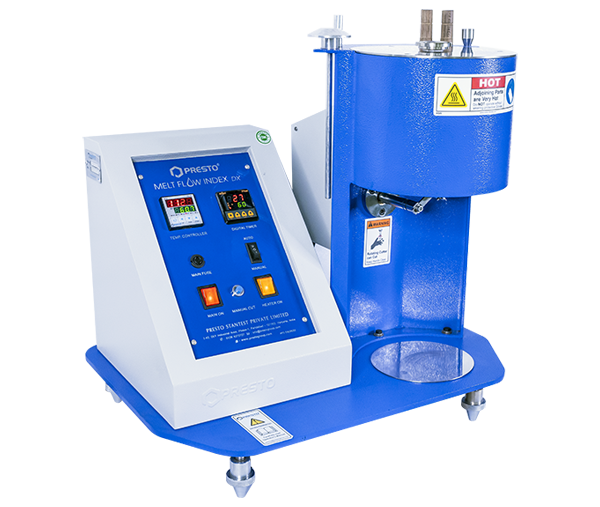
The working principle of a Melt Flow Index Tester is based on measuring the flow rate of molten plastic through a precision die under controlled conditions. The tester consists of a heated barrel, a piston assembly, standard weights, a die with a fixed orifice and a digital temperature controller.
The polymer sample is placed inside the barrel, which is heated to the required test temperature. After a specific preheating time, a standard weight is placed on the piston, forcing the molten polymer to flow through the die. The extruded material is either cut manually at fixed intervals or measured automatically by the machine.
The total weight of the extrudate collected over ten minutes is then calculated and reported as the Melt Flow Index of the material.
Types of Melt Flow Index Testers
Melt Flow Index Testers are available in both manual and automatic versions. Manual testers require the operator to cut and weigh the extrudate, whereas automatic testers are equipped with timers, encoders and digital weighing systems that eliminate human error and improve repeatability.
Advanced models also offer multi-weight loading systems, programmable test parameters and integrated printers for generating instant test reports.
Applications Across Industries
MFI testing is widely used in injection moulding units to ensure that the polymer flows correctly into mould cavities. In extrusion plants, it helps in controlling the thickness and uniformity of films, pipes and sheets. Blow moulding units rely on MFI values to ensure that bottles and containers maintain structural integrity.
Plastic raw material suppliers use Melt Flow Index Testers to certify material grades before dispatching them to customers. Packaging companies, automotive component manufacturers and consumer goods producers all depend on accurate MFI data to maintain consistent product quality.
Benefits of Using a Melt Flow Index Tester
The biggest advantage of using an MFI tester is process stability. By monitoring MFI values, manufacturers can detect changes in polymer properties early and make necessary adjustments before defects occur. It also reduces material wastage, improves machine efficiency and ensures uniformity across production batches.
Another major benefit is customer confidence. Providing MFI test reports along with material certificates builds trust and demonstrates a strong commitment to quality.
Why Choose Presto Melt Flow Index Testers
Presto Melt Flow Index Testers are designed with high precision temperature controllers, robust mechanical construction and user-friendly interfaces. They ensure accurate temperature stability, smooth piston movement and repeatable results even during continuous industrial usage.
The machines are compliant with international standards such as ASTM D1238 and ISO 1133, making them suitable for both domestic and export-oriented manufacturing units. Presto also provides excellent installation support, operator training and after-sales service, ensuring long-term reliability.
Conclusion
The Melt Flow Index Tester is not just another laboratory instrument. It is a critical quality control tool that directly influences production efficiency, product performance and customer satisfaction. By investing in a reliable MFI testing system, manufacturers can safeguard their processes, reduce defects and maintain a strong competitive edge in the plastic industry.
Call to Action
Take complete control of your plastic quality today with the Presto Melt Flow Index Tester.
📞 Call: +91 9210 903 903
📧 Email: info@prestogroup.com
🌐 Enquire Now: https://www.prestogroup.com/contact-us/