Hospitals today manage more data, patients, and departments than ever before. From patient registration and billing to lab reports and compliance records, every task depends on accurate information and smooth coordination. Managing all this manually or through disconnected systems creates delays, errors, and stress for staff. This is where HMIS Software plays a major role.
HMIS Software is not just a digital tool. In fact, it is a complete system that connects every department in a hospital and brings clarity to administration and reporting. By replacing paper files and manual work with automation, it helps hospitals work faster, smarter, and more efficiently.
Understanding HMIS Software in Hospitals
HMIS Software, also known as Hospital Management Information System, is a centralized digital platform designed to manage hospital operations. It brings together clinical, administrative, and financial data into one system.
Instead of different departments working with separate files or systems, a unified digital platform allows everyone to operate on a single interface. Patient information, billing details, reports, inventory, and staff records remain updated and easily accessible at all times.
The true strength of this system lies in its ability to simplify hospital administration and reporting, making daily operations more efficient and well-coordinated.
Challenges in Traditional Hospital Administration
Before understanding the transformation, it is important to know the problems hospitals face without a proper system.
Many hospitals continue to manage operations using paper-based methods or old systems that no longer meet modern needs. This leads to several issues:
Patient records are stored in paper files, making them hard to track
Billing errors occur due to manual calculations
Reports take days or weeks to prepare
Departments work in isolation
Data duplication causes confusion
Management lacks real-time information
These challenges not only waste time but also affect patient care and hospital growth. HMIS Software directly solves these problems.
How HMIS Software Improves Hospital Administration
Centralized Patient Information
One of the biggest improvements modern hospital systems bring is centralized patient data. From registration to discharge, every detail is stored in one secure place.
Patient history, doctor notes, lab results, prescriptions, and billing information are all connected. This helps administrative staff avoid repeated data entry and reduces mistakes.
When patient information is easily available, staff can focus more on service quality rather than paperwork.
Faster and Accurate Patient Registration
Manual patient registration often leads to long queues and errors. HMIS Software automates the registration process.
Basic details are entered once and reused across departments. This saves time and ensures accuracy. Returning patients can be registered in seconds, improving the overall patient experience.
Simplified Appointment and OPD Management
Managing appointments manually can cause overbooking, missed slots, and confusion. However, a digital system organizes OPD schedules clearly and ensures smooth patient flow.
Moreover, doctors, nurses, and reception staff can see real-time appointment status. Changes are updated instantly, thereby reducing patient wait time and improving coordination.
Streamlined Billing and Finance Management
Billing is one of the most critical parts of hospital administration, and as a result, errors here can lead to revenue loss and patient dissatisfaction.
Fortunately, the system automatically generates bills based on services provided, diagnostic tests performed, and medicines issued. This significantly minimizes calculation errors and maintains complete transparency in billing.
Additionally, insurance claims, discounts, and tax calculations are managed efficiently, ensuring financial records remain accurate and easy to audit.
Better Staff and Resource Management
Hospitals depend on skilled staff and limited resources. Managing shifts, attendance, and workload manually is difficult.
Administrators can easily assign duties, monitor attendance, and manage staff schedules through a centralized system. This supports better use of human resources, balances workloads, and helps prevent staff fatigue.
Equipment and room availability can also be tracked in real time, helping hospitals plan better.
Transforming Hospital Reporting with HMIS Software
Reporting is one area where HMIS Software creates the biggest impact.
Real-Time Data Access
Traditional reporting systems depend on manual data collection, which takes time and often contains errors. Departmental information is collected automatically without manual effort.
Administrators can access real-time reports anytime. This helps in quick decision-making and improves hospital performance.
Accurate and Consistent Reports
Manual reports often differ between departments due to data mismatch. It ensures uniform information across departments through a single, reliable database.
Whether it is patient count, revenue, bed occupancy, or department performance, reports remain accurate and reliable.
Customizable Reports for Management
Since every hospital has different reporting needs, HMIS Software allows administrators to generate customized reports.
For example, daily, weekly, monthly, or yearly reports can be created easily. As a result, management can analyze trends, identify issues, and plan improvements without depending on technical staff.
Compliance and Regulatory Reporting
Hospitals must follow strict healthcare regulations and submit reports to authorities. However, manual compliance reporting is time-consuming and risky.
By using structured data storage, compliance reporting becomes easier, faster, and free from unnecessary stress. As a result, it helps hospitals stay compliant and avoid regulatory problems.
Data-Driven Decision Making
With clear and accurate reports, hospital management can make informed decisions. Moreover, they can identify underperforming departments, track patient satisfaction, control costs, and plan future expansion. In addition, it helps transform complex data into clear, decision-ready information.
Improved Coordination Between Departments
Hospitals have many departments that depend on each other. Without a connected system, communication gaps occur.
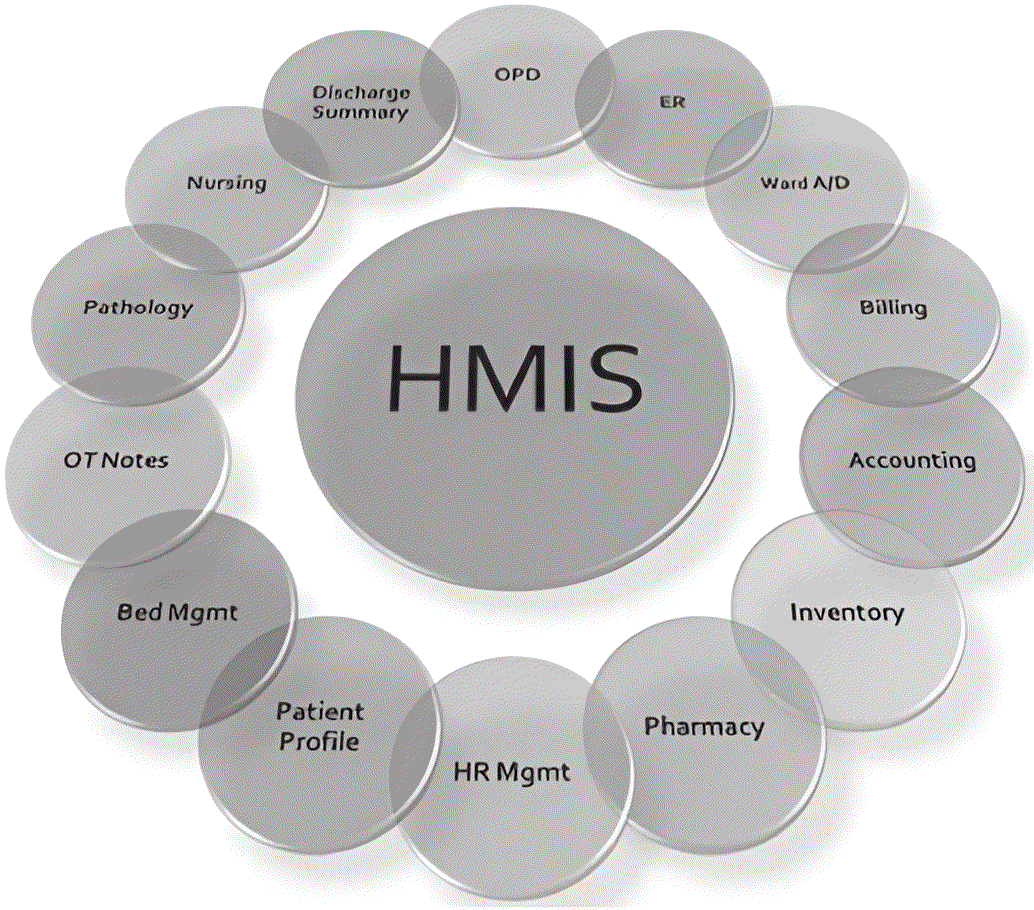
HMIS Software connects OPD, IPD, pharmacy, lab, radiology, billing, and administration. When one department updates data, others can see it instantly.
This improves teamwork, reduces delays, and ensures smooth patient flow across the hospital.
Enhanced Data Security and Privacy
Patient data security is a major concern in healthcare. Moreover, paper records and unprotected systems increase the risk of data loss and misuse.
To address this, it uses role-based access, encryption, and secure backups to protect sensitive information. Additionally, only authorized users can access patient data.
As a result, this protects patient privacy and builds trust in the hospital’s systems.
Reducing Administrative Workload
Administrative staff often spend most of their time on paperwork and data entry. It automates routine tasks.
This reduces workload, minimizes stress, and improves job satisfaction. Staff can focus on patient support and service quality instead of repetitive tasks.
Supporting Hospital Growth and Scalability
As hospitals grow, managing operations becomes more complex. HMIS Software is scalable and adapts to growth.
New departments, users, and services can be added without disrupting existing operations. This makes HMIS Software a long-term investment.
Why Modern Hospitals Depend on HMIS Software
Today’s healthcare environment demands speed, accuracy, and transparency. Consequently, hospitals that continue using manual systems struggle to meet patient expectations.
Fortunately, HMIS Software helps hospitals stay competitive, efficient, and patient-focused. It improves administration, strengthens reporting, and supports quality care.
Moreover, Hosval offers a reliable and user-friendly platform that addresses these challenges and fits hospitals of all sizes.
Key Benefits at a Glance
HMIS Software improves hospital administration efficiency. Moreover, it ensures accurate and fast reporting. It also reduces operational errors and delays, while enhancing patient satisfaction. In addition, it supports compliance and data security. Finally, it enables data-driven management decisions.
These benefits, therefore, directly impact hospital performance and reputation.
Future of Hospital Administration with HMIS Software
The future of healthcare is digital. Hospitals that adopt HMIS Software today prepare themselves better for the future.
Advanced analytics, AI-based insights, and mobile access will further enhance hospital administration and reporting. HMIS Software will continue to evolve, making hospitals smarter and more responsive.
Final Thoughts
Modern digital systems are no longer optional for hospitals aiming for efficiency and long-term growth. A Hospital Management Information System helps streamline hospital administration by automating routine tasks, improving coordination between departments, and minimizing operational errors.
These systems also transform reporting by delivering real-time, accurate, and meaningful information. With better insights, hospitals can enhance patient care, use resources more effectively, and make informed decisions that support sustainable success.
Selecting the right solution, such as Hosval, helps hospitals stay well-organized, compliant with regulations, and prepared to meet future healthcare challenges.
If your hospital is still struggling with manual processes, delayed reports, or disconnected departments, it is time to move forward.
Invest in a reliable HMIS Software solution today to simplify administration, strengthen reporting, and deliver better healthcare services.
Start your digital transformation now and build a smarter, more efficient hospital for the future.
Source URL : https://bizdirectoryhub.com/how-hmis-software-transforms-hospital-administration-and-reporting/